Consumer Guides

Government  Guides

Consumer News

Consumer Guide
Index

Consumer Guides
Home

Submit Government Guide

Submit Article
Consumer News Articles on
Products and Services

Copywriting Services

Auctions

Auction Houses

Internet Auctions

Adoption

Adoption Professionals

Adoption Record Access

Single Parent Adoption

Auto

Automobiles

Auto Directory

Auto Finance

Auto Insurance

Auto Leasing

Auto Auctions

Hybrids (HEV)

Biology

Human Genome Project

Business

Franchises

Business Transportation
Directory

Presidential Address:
Women's Small Business 
Owners

Jobs & Growth Act 2003

Investment Capital

Loan Request Documentation

Merchant Account Comparison

Cell Phones

Cell Phone Info

Computer

Broadband

Data Centers

E-Commerce Tips

Computers & Energy Star

Computer Shopping Page

Wifi Wireless Fidelity

Free Wifi

Consumer News Articles

Consumer News Articles

Forklift Batteries

Clean Energy Systems

Cosmetic Surgery and Financing

CD Manufacturing Services

Organic Baby Furniture

LASIK Procedures and Costs

Culture

Hispanic Heritage Month

Customer Service
Profiles

Digital Photography

Digital Photography Directory

Disabilities

National Disability Employment 
Awareness Month

New Freedom Initiative

FAQ's Disabilities and Work

Workforce Investment Act

Disaster Help

Guide to help
Rebuild Your Home

DVD's

Guide to DVD's

Earthquakes

Preparation, Survival

Electronics

HDTV

Employment

Interviewing

Accountants & Analysts

Administrative Service Managers

Budget Analysts

Construction Managers

Cost Estimators

Employment Interviewers

Engineering, Science, Computer
Systems Managers

Financial Managers

Job Training Initiative

Purchasers / Buyers

Education

Graduate Degrees

Distance Learning

Types of Colleges

Educational Software
Distributors

Original Educational
Software
Initiative by
President Bill Clinton

Energy

Biomass

Buying Clean Electricity

Energy Star

Geothermal

Hydrogen Fuel Cells

Hydropower

Solar

Wind Power

Zero Energy Buildings

Energy Star Technology

Energy Star Homes
FAQ's

Presidential Energy Address
April 2005

Computer Buyers Guide

Energy Star

Spectrally Selective
Low-E Glass

Fashion

Women's Clothing

Financial

Accept Credit Cards

Actividades Bancarias

Bankcruptcy

Capital Access
Grants, Loans

Check 21

Check 21 FAQ

Consumer Credit

Credit Cards

Currency & Coins

Currency: Buying, Selling
Redeeming

E-Commerce Associations
Directory

Electronic Banking

FDIC Insurance

Fair and Accurate Credit
Transaction Act of 2003

Forex Brokerages Directory:

Merchant Accounts

Merchant Account Services
Costs and Fees

Money & Credit Cards

Payment Processing

Stock Market Basics

Fishing

Fishing Guide

Government Info

Government Grant Info

Global Warming Facts

Homeland Security

Preparing America

U.S. Immigration and Visas   

Health

Hospital Comparison

FDA News Digest 
Dec. 03
Contaminated food warnings;
New Drug Treatments ... more

Health Insurance
HIPPA
Government Health Guides

Bird Flu News

What is Influenza? (Flu)

Vioxx

FDA on Vioxx

FDA Vioxx - Press Release

FDA Q & A Vioxx

Identity Theft

Consumer Confidential: 
The Privacy Story

New Law Signed
By President Bush

Information

Information Bank

Insurance

Life Insurance

Long Term Care
 

Jets: Private

Business Aircraft

Cessna

Eclipse 500

Lear

Jewelry

Jewelry Guide

Precious Stones

Legal Guides

Legal Resources

Legal News

Stevens-Johnson
Syndrome

Machinery

Farm, Food Processing
Packaging

Medicare

Medicare Premiums 2004

The Medicare Prescription 
Drug Improvement and 
Modernization Act of 2003

New Medicare Law - FAQ's

Patents & Trademarks

Patents, Trademarks, Copyrights

Press Releases
For Immediate Release

Politics

Political News

Barack Obama

Real Estate

100 Q & A's of
Home Buying

American Dream 
Downpayment Act 

Pardee Homes

Fair Housing Quiz
(HUD)

Financing Energy
Efficient Homes

Home Buying

Home Buying FAQ

Home Buying
Glossary

Home Buying Loans

Home Mortgage
Insurance

Manufactured Homes

Mortgage Refinance

Selling Your Home

Ten Tips For Home Buyers

Real Estate Directories

Sustainable Design:
Energy Efficient Homes

Soccer

Soccer.com
Free Soccer Posters
Shopping

Specialty Directories

Offshore Directories

Real Estate Directories

Featured Directories

Taxes

Tax Tips

Bush Tax Cut

Technology

Data Centers

Megosearch

Nanotechnology


Time

Correct Time

Toxicology

Asbestos Issues

Legislative 

Sen. Bill Frist 

Sen. Hatch

Sen. Murray

Analysis - 
Asbestos Information Act of 1988
H.R. 5442

Benzene

Travel

Tips For Women
Traveling Alone

U.S. Immigration and Visas

State Department Travel Tips

Other Online Guides

e-Commerce

Shopping  

________
Disclaimer

Contact


Solar Power Photovoltaics

Source: U.S. Department of Energy

Knowledge of the sun's ability to produce both heat and electricity has led to the invention of several technologies for generating electricity from the sun's energy. These technologies comprise photovoltaic and concentrating solar power (also known as solar thermal electric) systems.

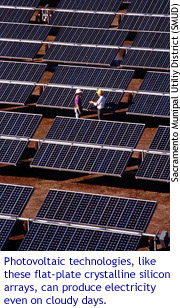
Photovoltaic technologies, like these flat-plate crystalline silicon arrays, can produce electricity even on cloudy days. (Sacramento Municipal Utility District (SMUD))How Photovoltaics Work

Photovoltaic (PV) technologies produce electricity directly from sunlight. When sunlight strikes the semiconductor materials out of which PV technologies are made, a portion of that light is absorbed. If the energy from the absorbed light strikes electrons in the outer shell of an atom, these electrons are freed from their parent atoms. Free electrons can then travel into a circuit in the form of electricity.

The most common PV device available today is made from rigid, crystalline silicon solar cells (although other materials can also be used). About 40 of these cells are typically combined to produce a flat module, and about 10 of these modules are mounted to form a PV array, which can measure up to several meters on a side. PV arrays can be mounted at a fixed angle facing south, or they can be mounted on a tracking device that follows the sun, allowing them to capture the most sunlight over the course of a day.

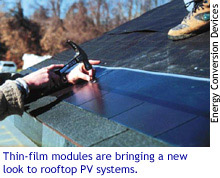
In addition to PV arrays, flexible sheets of thin-film PV modules, made with various non-crystalline materials, are just now starting to enter the commercial and residential buildings market for use as rooftop shingles. These modules have traditionally been used in consumer electronics.

Thin-film modules are bringing a new look to rooftop PV systems. (Energy Conversion Devices)The performance of a PV technology is measured in terms of its efficiency at turning sunlight into electricity. Only sunlight of certain wavelengths will work efficiently to create electricity, and much of it is reflected or absorbed by the materials that make up the cell. Researchers are working to improve PV module efficiencies while holding down the cost.

How Photovoltaics are Used
Traditionally, PV has been used to power anything from watches and calculators to structures such as individual homes in locations where it is expensive or impossible to send electricity through power lines. Some homeowners now also use PV to supplement the electricity supplied to them from the grid. Our Making Your Own Clean Electricity section provides more information on issues involved with producing your own electricity.

PV systems can be sized to meet both large and small electricity supply applications. An increasing number of power companies are now experimenting with using crystalline silicon PV to meet some of their power needs. Our Buying Clean Electricity section provides information on buying electricity generated from PV and other renewable energy technologies in your state.

Where Photovoltaics are Used
The solar resource across the US is ample for PV systems, because these technologies are able to use both direct and scattered sunlight. However, the amount of power generated by a solar device at a particular site depends on how much of the sun's energy reaches it. Thus, PV systems, like all solar technologies, function most efficiently in the southwestern United States, which receives the greatest amount of solar energy.

Knowledge of the sun's ability to produce both heat and electricity has led to the invention of several technologies for generating electricity from the sun's energy. These technologies comprise photovoltaic and concentrating solar power (also known as solar thermal electric) systems.

How Concentrating Solar Power Technologies Work
Large-scale concentrating solar power (CSP) technologies—parabolic troughs and power towers—focus the sun's heat onto a receiver using reflectors. The receiver collects the sun's heat, which can then be converted into electricity using a steam generator.

Parabolic-trough systems concentrate the sun's energy through long rectangular, curved (U-shaped) reflectors. The reflectors are tilted toward the sun, focusing the sun's energy on a pipe that runs down the center (focal point) of the trough. This heats oil flowing through the pipe. The hot oil then is used to boil water in a conventional steam generator to produce electricity.

A power tower system uses a large field of reflectors to concentrate the sun's energy onto the top of a tower, where it heats a receiver filled with a heat-exchange fluid, such as oil. The heated fluid is then used to generate electricity in a conventional steam generator. Systems using molten salt as the heat-exchange fluid retain heat very efficiently, enabling them to produce electricity up to three hours after the sun has set.

How Concentrating Solar Power Technologies are Used
These technologies are currently in different stages of development.

Troughs have a proven track record as a technology that can function effectively for large-scale power needs (such as those of a power company), and are currently the least expensive way to produce solar electricity. Our Buying Clean Electricity section provides information on buying electricity generated using CSP and other renewable energy technologies in your state.

Power towers have also demonstrated their efficiency in demonstration projects, although they are not yet in use commercially.

Where Concentrating Solar Power Technologies are Used
The amount of power generated by a solar device at a particular site depends on how much of the sun's energy reaches it. Thus, all solar technologies function most efficiently in the southwestern United States, which receives the greatest amount of solar energy. CSP systems, especially, are considered most feasible in the desert Southwest because they rely on the solar energy which hits their reflectors directly (unlike photovoltaic and solar hot water systems, which are able to use both direct and scattered sunlight).


Buying Clean Electricity

Solar

Geothermal

Wind Power

Biomass

Hydropower

Energy Star

Fuel Cells

Zero Energy Homes


Google


Web www.consumer-guides.info


Vote:
There's a lot at stake...


© 2001-2008 Consumer-Guides.Info
Contact