Small Aircraft Propulsion: The Future Is Here
Glenn Propulsion Program Opens the Door to a New Era in General
Aviation
NASA's General Aviation Propulsion (GAP) program has turned
vision into reality. At the beginning of the GAP program, NASA
promised to transform small aircraft by developing revolutionary new
engines and demonstrating them in the year 2000. These radically
advanced engines will enable the general aviation industry to
produce innovative, affordable engines for the commercial market.
Although current general aviation engines are good and have
served their purpose well, they require considerable pilot
attention, intrude on passenger comfort with noise and vibration,
and are costly to buy, operate, and maintain.
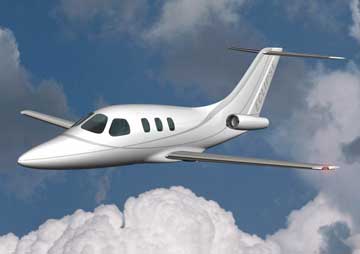
Image right: The
Eclipse 500TM, a six-passenger jet made possible by
revolutionary EJ22 turbofans, which are commercial derivatives of
the GAP FJX-2 turbofan. Credit: NASA
The new GAP engines will change all of that, along with our ideas about
what general aviation propulsion systems can be. With their smooth,
quiet operation, they provide comfort never before enjoyed in
general aviation light aircraft. New engines are crucial to truly
new airplane designs. The GAP engines are bringing about a
revolution in light aircraft affordability, ease of use, and
performance.
These new engines are key to creating a small aircraft
transportation system in the United States. The potential is
especially strong when the benefits of the new
propulsion systems
are coupled with those of cockpit and airframe technologies
developed by the NASA-FAA-industry Advanced General Aviation
Transport Experiment (AGATE) consortium.
The GAP Diesel Engine
The jet-fueled GAP diesel engine will make possible outstanding
new propulsion systems for entry-level aircraft. Such aircraft are
usually characterized by a single engine, up to four seats, cruise
speeds of 200 knots or less, and easy, well-mannered handling.
The GAP program goal for piston engines was to reduce engine
prices by half while eliminating the need for leaded gasoline and
substantially improving reliability, maintainability, ease of use,
and passenger comfort. To achieve this goal, Teledyne Continental
Motors and it's industry team (Aerosance, Cirrus Design, Hartzell
Propeller, Lancair, and Mod Works) partnered with NASA Glenn to
develop a highly advanced piston engine, the GAP diesel engine.
Diesel engines are known for being reliable but have been considered
too heavy for use in general aviation. Combining the two-stroke
operating cycle with innovative, lightweight construction makes the
GAP diesel engine competitive with current piston aircraft engines.
The GAP diesel engine, combined with advanced-design low-speed
propellers (from related NASA-industry research), offers very quiet
operation for both passengers and airport neighbors. Additionally,
the new engine is very economical to operate. It has been designed
to burn readily available jet fuel at a low fuel consumption rate of
about 25 percent less than current engines.
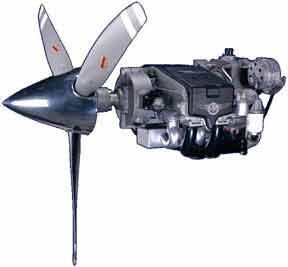
Image above:
Revolutionary diesel engine developed in the GAP program. Credit:
NASA
This engine provides pilots and passengers with the same kind of
quiet, easy-to-use power that we have come to expect in our
automobiles. There is no fuel-air mixture or propeller pitch control
for pilots to contend with. A single power lever controls the engine
and propeller automatically, much like the gas pedal of a car with
an automatic transmission. Other special design features ensure
extremely smooth, vibration-free operation. And because the GAP
diesel's unique design allows use of low-cost mass production
manufacturing methods, engine cost could be half that of current
aircraft piston engines.
The FJX-2 Turbofan Engine
Modern turbine engines are highly desirable aircraft propulsion
systems because they are user-friendly and environmentally
compliant. They are characterized by very high reliability, smooth
operation, use of readily available jet fuel, and low noise and
emissions. Their reliability and smoothness contribute greatly to
aircraft safety and comfort. But, until now, the use of turbine
engines in the light aircraft market has been limited by high cost.
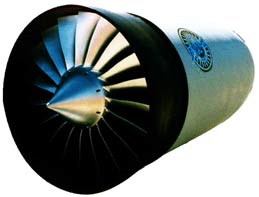 Image right: The
revolutionary FJX-2 turbofan engine developed in the GAP program.
Credit: NASA
Image right: The
revolutionary FJX-2 turbofan engine developed in the GAP program.
Credit: NASA
With the development of the FJX-2 Turbofan engine, the GAP program is
helping to reduce the cost of small turbine engines by a factor of
ten and revolutionize the concept of personal air transportation.
The FJX-2 has enabled a whole new class of aircraft: safe,
affordable, fast, efficient small jets in which the family can
travel in comfort. At a fraction of the cost, this new turbine
engine has made the performance of a commercial jet available to the
general aviation community, including cruise speeds of 380 knots
(440 mph) and the ability to fly over or around inclement weather.
The FJX-2 is a high-bypass-ratio turbofan engine that produces
700 pounds of thrust, yet weighs only 85-100 pounds, about
one-fourth the weight of piston engine propulsion systems with
similar capabilities. To keep costs low, the FJX-2 team applied many
lessons learned from research of automotive gas turbine engines.
Emphasis was placed on simplifying design and reducing the number of
parts. Low-cost design techniques and advanced automated
manufacturing methods have led to the first turbine engine that is
cost competitive with piston engines. While not as fuel efficient as
today's comparable piston-powered aircraft, new turbofan jets will
have equivalent or lower takeoff-to-landing fuel consumption.
The FJX-2 was developed in partnership with NASA Glenn by
Williams International and its industry team (California Drop Forge,
Cessna Aircraft, Chichester-Miles Consultants, Cirrus Design, Forged
Metals, New Piper Aircraft, VisionAire, Producto Machine, Scaled
Composites, and Unison Industries).
The Future Is Here
The General Aviation Propulsion Program has delivered on its
promise to propel the general aviation industry to new heights.
Commercial derivatives of the GAP diesel engine and the FJX-2
turbofan engine will provide a previously unheard-of level of
comfort and convenience, and the performance-to-price ratio will
soar. The Eclipse 500TM aircraft, made possible by the
revolutionary EJ22 turbofan (a commercial derivative of the GAP
FJX-2), is just the first example of a new generation of aircraft.
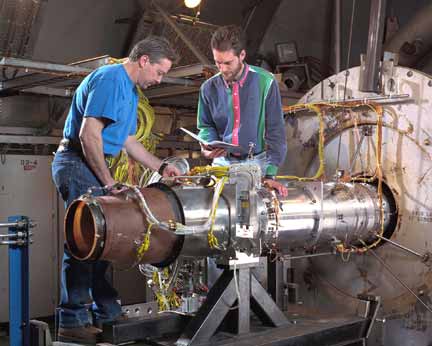 Image
left: The FJX-2 turbofan engine in Glenn's Propulsion Systems Lab (PSL)
altitude test chamber. PSL is NASA's only ground-based test facility
capable of true flight simulation for experimental research on
air-breathing propulsion systems. Credit: NASA
Image
left: The FJX-2 turbofan engine in Glenn's Propulsion Systems Lab (PSL)
altitude test chamber. PSL is NASA's only ground-based test facility
capable of true flight simulation for experimental research on
air-breathing propulsion systems. Credit: NASA
The Glenn Research Center is continuing its contributions to NASA's new
Small Aircraft Transportation System (SATS) initiative. Innovations
such as oil-free engines and affordable high-performance lightweight
materials will continue the revolution in propulsion technologies
for general aviation.
NASA, with its government and industry partners, is putting
America on wings!
|